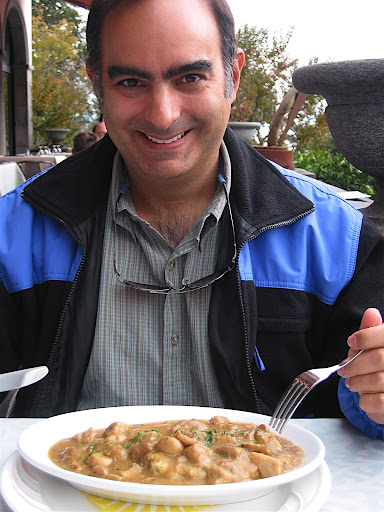
Canadian Swiss commented on the previous post about doing Risotto by de-glazing the pan that the saltimbocca gets cooked it. I tried it out, more or less, by dumping some previously cooked risotto into the pan I cooked my saltimbocca in after de-glazing the pan with some chasselas that I use as cooking wine.
The results were great. Though I still need to try it out with Marsala wine as she suggests. I think it's probably enough just to dump the risotto in after it cooks (I do things the easy way and use the pressure cooker, which is even easier than the cookbooks suggest) and keep it warm for a bit while mixing it around. This was also a very handy use of the big cooking pan that goes on my European Outoor Chef BBQ.
Thursday, October 18, 2007


Thursday, August 9, 2007
Saltimbocca
 |
| From Dishes |
I've neglected this blog for awhile, but I really should do a bit more with it. I've got a new BBQ, and have been cooking up a storm on it. But here's a recipe I've been planning to write down for quite a while, so here it goes.
Saltimbocca is a great dish to make for guests. It's easy, it tastes GREAT, it's quick and it goes with nice full-bodied wines. It's very flavorful, so even though it's not the lowest fat thing to eat, you're probably not going to be eating more that a couple of pieces, so you can round it out with a bunch of veggies, potatoes, rice or noodles and make it a pretty healthy meal overall.
As I mentioned it's pretty wine friendly. Both in that it tastes great with full-bodied red wines, and that if you've already had a couple of glasses, it's still easy to cook. And, it always impresses anyone who's never had this dish before.
Saltimbocca
- Two thinly cut veal steaks about the size of a deck of playing cards per person. (Beef, pork chops w/o bone, turkey or chicken breast can be substituted)
- Four slices Bundner Rohschenken per person. (Parma Prosciutto can be substituted.
- Two to Three sage leaves per steak. (dried is okay, fresh is great).
- Salt and Pepper to taste.
You can prepare the meat ahead of time and put in the refrigerator.
For each steak, season with salt and pepper (and I often add a bit of garlic powder) then wrap in the rohschenken or prosciutto. Use two toothpicks per steak to hold in place. If you have some nice big fresh leaves of sage, you can also stick these together on the outside of everthing with the toothpicks.
Start off cooking by heating some olive oil in a frying pan over medium heat. Use a good pan and you won't need the heat too high. If you're using dried sage leaves put a couple down in the oil just before adding the steak atop the sage leaves. Fry the steaks until the Rohshenken is well browned. Don't worry about over cooking, it just gets tastier the longer you cook it. Serve when well browned. I like the sage leaves on top of the saltimbocca as they absorb a lot of flavor from the rohshenken/prosciutto, but some people prefer not to eat them as the look a bit burned.
Wednesday, May 9, 2007
Hungarian Paprika!
 |
| From Budapest |
While we were on a trip to Budapest, Hungary, we noticed a post card with a wonderful looking market on it. We asked our friends who were showing us around where that market was, and they mentioned it was near our hotel. So, on our last day in Budapest we planned our day; First we would go up the hill with the citadel on it, and then we would walk across the Elizabethan bridge and go to the Market.
In Pest's market there are all sorts of intersesting stands and shops. Many sell vegetables, wine, meat, bread or even, as in the one in the photo, Paprika.
At first it was quite confusing what to buy. A lot of the paprika looks packaged for tourists, with wooden spoons and recipes attached. We wandered around the market, and asked one of the vendors what the differences were in Paprika sold.
The vendor mentioned there were hot and sweet paprikas, but the quality between brands weren't so different. However, there were differences in paprikas with some slightly cheaper varieties having seeds included in the mix, and those slightly more expensive having no seeds in the mix.
I purchased about 1kg of paprika to take home. With 500g being a big bag of regular grade sweet paprika, a small bag of flake and seeds, and two tins of paprika without seeds (and a inexpensive package of saffron threads).
I don't have a recipe yet to post on using paprika, though I plan on trying to come up with a version of the paprika potatoes I had at the open air museum near Szentendre. I have been trying out the paprika, using it to replace the chili powder in enchilada sauce and potato curry so far. I've also made some paprika chicken that turned out pretty tasty. While it is much milder than the hot red chili powder I use in most of my Mexican cooking, it has a nice subtle taste, and is great to use when you want a lot of nice color in the meal without too much heat.
Saturday, April 14, 2007
Greek Salad
While I'm neither Greek, nor a salad. I often enjoy putting together a Greek Salad. It makes a nice light lunch for us and is also quite tasty. I put one together for lunch today, and promptly forgot to take a picture of it.
One thing that's good to have when you're making a Greek Salad is an olive pitter. It's really a pain to chew around those olive pits while eating the salad. A few minutes spent taking those pits out makes the salad much more enjoyable.
Traditionally, I think the salad will have raw onion, as we're usually having it for lunch, we skip the onions. I also add a bit of iceberg lettuce to make it more like a traditional salad.
- 1 large english cucumber
- 3 roma tomatoes
- 1 tablespoon red wine vinegar
- 3 tablespoons virgin olive oil
- 20 (or so) Kalamata or salty Greek olives
- 1 tablespoon Oregano
- 1/2 head of iceberg lettuce
- 100g Feta cheese (I use a great 1/4 fat cheese I find here in Switzerland and France).
- Salt to taste.
Grab your big salad bowl, and add the oregano, vinegar, olive oil and salt. Mix it up a bit, and let the vinegar and oil absorb some of the oregano taste.
Dice up the Feta cheese and add it to the salad dressing. Mix it up lightly.
Pit the olives if desired. Add olives to the salad dressing.
If desired, peel the cucumber, and then cut it four times lengthwise. Cut each segement into quarters across the end and then slice the four sticks so you get quarters of a slice of cucumber. Thow the cucumber into the salad bowl.
Cut up the lettuce, or if you do it the way I do and use a package of "Bag O'Salad" and put it into the bowl.
Mix the salad well. This way the dressing gets all of the blander parts of the salad covered with tasty salad dressing.
Dice the tomatoes and add them to the top of the salad. Serve immediately.
Serves two as main course, six as starter salad.
Tuesday, March 27, 2007
Enchiladas
When I lived in the Seattle area. I never cooked mexican food. Never! NEVER! Not with great burrito shops all over the place, which great barbequed meat. One of my favorite places had some great pinapple salsa. Anyways, now that I'm in Switzerland, instead of a great burrito for about five dollars, I can buy one about half as good for about 25 dollars. So, yeah, I make my own mexican food now.
In Basel, I usually go for supplies at El Sol currently in Dreispitz. They have pretty much the best tortilla chips and corn tortillas that you'll find here in Switzerland. In Zurich, you'll want to shop down by the train station at El Maiz who has a great selection, often including fresh jalapeno peppers and tomatillos. I get my enchilada sauce at El Maiz, as I haven't found a good recipe for it yet. Besides, the canned stuff is good enough.
If you use the canned sauce, Enchiladas are pretty easy to make. Some soak the tortillas in water, others cook them quickly in oil or in the sauce. I noticed the last time I made the enchiladas, that if I let the tortillas warm up to room temperature, then they were flexible enough to roll.
Prehead oven to 200C
Chop the onion and slice the olives, place into a bowl, or a ziplock bag.
Using two forks, shred the chicken meat, if you're making chicken enchiladas. Add to the bowl/bag
Grate the cheddar cheese. If making cheese enchiladas, add all but 50g to the bowl/bag.
Mix ingredients in the bowl or bag well. Add three tablespoons of enchilada sauce to the mix only if you are making chicken enchiladas.
Pour about 1/4 of the sauce on the bottom of a medium glass casserole dish
Take a small handful of mixture and put it on a tortilla, and then roll the tortilla closed, and place the enchilada on the casserole dish with the seam down. Repeat until finished with the tortillas.
Pour the rest of the sauce over the enchiladas, covering them well. Sprinkle the rest of the cheddar cheese over the enchiladas.
Place dish in oven and cook at 200C for about 30 minutes. Let cool for about 5 minutes before serving.
In Basel, I usually go for supplies at El Sol currently in Dreispitz. They have pretty much the best tortilla chips and corn tortillas that you'll find here in Switzerland. In Zurich, you'll want to shop down by the train station at El Maiz who has a great selection, often including fresh jalapeno peppers and tomatillos. I get my enchilada sauce at El Maiz, as I haven't found a good recipe for it yet. Besides, the canned stuff is good enough.
If you use the canned sauce, Enchiladas are pretty easy to make. Some soak the tortillas in water, others cook them quickly in oil or in the sauce. I noticed the last time I made the enchiladas, that if I let the tortillas warm up to room temperature, then they were flexible enough to roll.
Enchiladas (serves 3)
- 6 corn tortillas
- 1 small onion
- 50g black olives, pitted if possible
- 1 16oz can of enchilada sauce
- 250g cheddar cheese for cheese enchiladas OR 50g cheddar cheese for chicken enchiladas
- 200g chicken meat, skinned and boned, baked ahead of time. (If, obviously, you're making chicken enchiladas)
Prehead oven to 200C
Chop the onion and slice the olives, place into a bowl, or a ziplock bag.
Using two forks, shred the chicken meat, if you're making chicken enchiladas. Add to the bowl/bag
Grate the cheddar cheese. If making cheese enchiladas, add all but 50g to the bowl/bag.
Mix ingredients in the bowl or bag well. Add three tablespoons of enchilada sauce to the mix only if you are making chicken enchiladas.
Pour about 1/4 of the sauce on the bottom of a medium glass casserole dish
Take a small handful of mixture and put it on a tortilla, and then roll the tortilla closed, and place the enchilada on the casserole dish with the seam down. Repeat until finished with the tortillas.
Pour the rest of the sauce over the enchiladas, covering them well. Sprinkle the rest of the cheddar cheese over the enchiladas.
Place dish in oven and cook at 200C for about 30 minutes. Let cool for about 5 minutes before serving.
Sunday, March 18, 2007
Fennel Salad
Until I moved to Switzerland, I had never had fresh fennel. Sure, I'd had sausages with fennel seeds in them, but that was pretty much it for fennel. Then my Frau cooked me some fennel with carrots. That was pretty good, but the best fennel dish I've had is a salad made by a local restaurant, Bodega Zum Strauss, here in Basel. Since trying the salad there, I've been trying to figure out how it is made. This is a good try at what it is like. What's important is to not overpower the fennel with the salad dressing.
- 1 bulb fresh fennel
- 30g chunk parmesan cheese
- 3 teaspoons olive oil
- 1 teaspoon white balsamic vinegar
- dash of garlic powder
- salt and white pepper to taste
Mix the olive oil, vinegar, garlic powder, salt and pepper together in the bowl you will be serving the salad in.
Slice the fennel as thin as possible, a food processor is good for this. Mix fennel with the dressing.
Make shavings of the paremesan cheese with a vegetable peeler. A wider piece of cheese is nice to use as you get big slices of parmesan.
Place salad in bowls and top with the parmesan cheese. Serve.
Thursday, March 1, 2007
Pita Bread

When I first arrived in Switzerland, I looked around for some decent pita bread. I really didn't find much. I've found these things in the supermarket that are in air-tight plastic and last a decade or so (just kidding, they only last about three months). They're not bad, but they're not like the fresh pita I used to find in the supermarkets in Seattle.
Our landlord was having a birthday party, and we were invited. I thought it would be fun to put together a couple of snacks to bring along with us. PIco di Gallo and tortilla chips was an easy thing to do. I thought that it would also be a good idea to make some Hummus. I used the recipe out of Madelain Farah's "Lebanese Cuisine" cook book. While looking up that recipe, I saw a recipe for pita bread. It's a great recipe, and the results were some very good bread. Be aware though, the recipe makes five or six pretty big pitas. I served the bread to the Swiss (all Swiss but myself) party guests. The Swiss are pretty picky about bread, but they seemed to really enjoy it, and there weren't any leftovers of the bread.
As for Hummus, I have yet to find any that is any good. It's not hard to make if you've got a blender, so homemade is best.
Subscribe to:
Posts (Atom)